



Services
DEXA TBS Bone Density at RAVE: Advanced Screening for Stronger Bones
Integrated Trabecular Bone Score
At Radiology Associates of Venice, Englewood, and Sarasota, our DEXA bone density scans with Trabecular Bone Score (TBS) provide a comprehensive assessment of bone strength and fracture risk, detecting osteoporosis with unmatched precision. Bone density scanning is an advanced form of radiology that is used to measure bone loss. DEXA is the most current standard for measuring bone mineral density (BMD). We now offer DEXA with TBS. This quick, non-invasive, low-radiation procedure, completed in 10-20 minutes, equips you to safeguard your bone health. Don’t wait, early detection prevents fractures.
Call (941) 488-7781 now to schedule your DEXA TBS scan at one of our convenient locations!


What is a Bone Density Scan With TBS?
This scan masterfully combines DEXA technology with Integrated Trabecular Bone Score (TBS).
What is TBS?
TBS is an advanced imaging software provided for use as a complement to BMD measurement. TBS stands for Trabecular Bone Score and is an indicator of bone microarchitecture’s quality and independent parameter for fracture risk prediction. TBS Scores are provided for all patients that have an AP Spine Scan. TBS algorithm analyses DEXA images in two dimensions to evaluate the three-dimensional bone structure.
Who Will Benefitt The Most From This Scan?
TBS has the following clinical benefits in:
Primary Osteoporosis: Patient in Osteopenia category with low TBS have a risk of fracture as high as osteoporotic patients.
Secondary Osteoporosis: TBS identifies patient at risk for in Diabetes, Glucocorteroid induced osteoporosis, Kidney, and Thyroid disease.
Treatment initiation and monitoring: TBS, BMD, and clinical risk factors, can be used to determine whether treatment should be initiated in untreated patients, TBS is potentially useful for monitoring anabolic therapy.
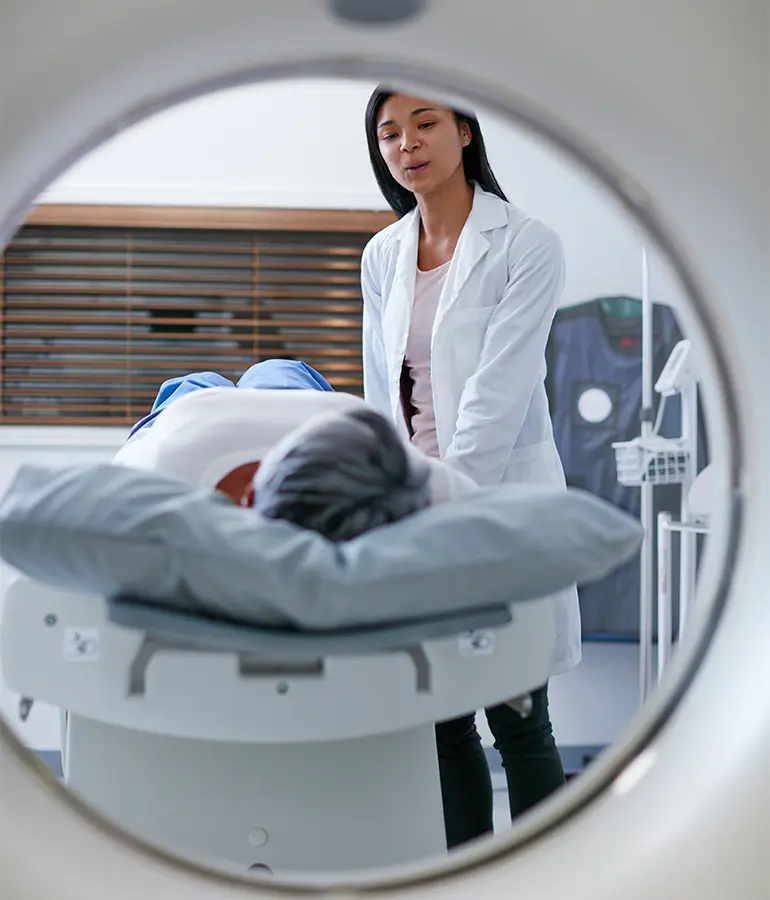
Osteoporosis can be characterized by low mass and micro-architectural deterioration. BMD T-scores are the gold standard to diagnose osteoporosis but are related to mass only. 50% of fractured patients do not belong to “osteoporosis” category because bone is complex, and BMD cannot explain all fractures. A degraded bone structure (assessed by TBS) can explain most fractures, not identified by BMD. The conjunction of BMD and TBS helps identified more patients at risk of fracture.
Your Physician May Order a Bone Density Test With TBS If:
- you have had X-Ray’ s showing vertebral fracture
- you have been diagnosed with osteoporosis
- you are a post-menopausal woman, not on estrogen therapy
- you are a post-menopausal woman who is 5’7″ or less than 125 pounds
- you have history of or family history of smoking or hip fracture
- you have a thyroid or parathyroid condition
- you have type 1 diabetes, kidney disease, or liver disease
- you are a man with medical conditions known to cause bone loss
- you have high levels of collagen in urine specimens