

Kyphoplasty for Spinal Fractures
Spinal Fractures
Osteoporosis causes more than 700,000 spinal fractures each year in the U.S. A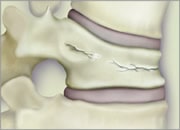 ccording to the National Osteoporosis Foundation, this is more than twice the annual number of hip fractures.
Spinal fractures can also be caused by cancer, the most common being multiple myeloma, breast, lung and prostate. According to the Multiple Myeloma Research Foundation, the majority of patients with multiple myeloma – some 70 to 95% -- have progressive metastatic bone disease particularly in the spine, which increases the risk of fractures.
Some spinal fractures may collapse immediately while others collapse over time. Left untreated, one fracture can lead to subsequent fractures, often resulting in a condition called kyphosis, or rounded back. Kyphosis, signified by the dowager’s hump, compresses the chest and abdominal cavity, resulting in serious negative health consequences.
The Balloon Kyphoplasty Procedure
- Using a needle and tube, the spine specialist creates a small pathway into the fractured bone. A small, orthopaedic balloon is guided through the tube into the vertebra. The incision site is approximately 1 cm in length.
- The balloon is carefully inflated in an attempt to raise the collapsed vertebra and return it to its normal position.
- Inflation of the balloon creates a void (cavity) in the vertebral body.
- Once the vertebra is in the correct position, the balloon is deflated and removed.
- The cavity is filled with bone cement forming an “internal cast” to support the surrounding bone and prevent further collapse.
- Generally, the procedure is done on both sides of the vertebral body.
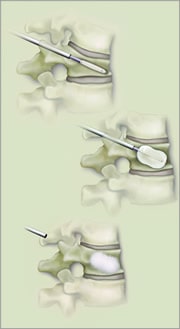 The Balloon Kyphoplasty procedure typically takes about one hour per fracture and may require an overnight hospital stay. The procedure can be done using either local or general anesthesia; the surgeon will determine the most appropriate method, based on the patient’s overall condition.
In most cases, Medicare provides coverage for Balloon Kyphoplasty. Other insurance plans often also cover the procedure.
Although the complication rate with KYPHON® Balloon Kyphoplasty has been demonstrated to be low, as with most surgical procedures, there are risks associated with the procedure, including serious complications. This procedure is not for everyone. A prescription is required. Please consult your physician for a full discussion of risks and whether this procedure is right for you.
Since its founding in 1994, Kyphon has been dedicated to improving patient quality of life by revolutionizing the practice of medicine. A recognized global leader in restoring spinal function with minimally invasive therapies, Kyphon maintains its commitment to ongoing research, innovative product development and advanced professional and patient education. Kyphon was acquired by Medtronic, Inc. in November 2007 and is now part of Medtronic’s Spinal and Biologics business.
Balloon Kyphoplasty Outcomes
Balloon Kyphoplasty is a minimally invasive, orthopaedic treatment that stabilizes spinal fractures, thereby reducing pain and correcting vertebral deformity. Studies report the following benefits:
- Correction of vertebral body deformity
- Significant reduction in back pain
- Significant improvement in quality of life
- Significant improvement in mobility, including the ability to perform daily activities such as walking, hobbies and work
- Significant reduction in the number of days per month that a patient remains in bed
- Low complication rate (<1%)
Patient Testimonials
Christine Siegel
 Teacher. Age: 57
Diagnosis: Multiple myeloma-induced fracture
“I threw away all of the pain killers. The cancer caused me to fall apart. This procedure put me back together again.” Being diagnosed with multiple myeloma is frightening enough; add compression fractures to the devastating complications of the disease, and Christine Siegel’s life became even more difficult. Over the course of six months, Christine lost six inches of height because of spinal fractures. She was bedridden for over a year and taking narcotics for pain. In May 2003, she underwent Balloon Kyphoplasty to repair four fractures and threw away all of the pain medication.
Chris Kern
 Former x-ray technicians. Age: 84
Diagnosis: Osteoporotic fracture
“The difference in the way I feel is like night and day.”
One night, a few hours after helping her wheelchair-bound roommate to bed, Chris Kern awoke with severe back pain. Over the next four months, she went in and out of the hospital, relying on narcotics to control the pain. Because she couldn’t eat, Chris lost over 30 pounds. Finally, she insisted a back x-ray be taken and reviewed by an orthopaedic surgeon. In August 2003, four compression fractures were found. After having the Balloon Kyphoplasty procedure, Chris has experienced a dramatic improvement in the way she feels.
Joan Schoengold
 Retired hospital administrator. Age: 82
Diagnosis: Osteoporotic fracture
“I felt better right away. I’ve been able to keep my independence and go back to taking care of myself. It’s like a miracle.” When you have osteoporosis, falling down can be disastrous. Joan had the flu and fainted walking into the bathroom. “When I woke up, I was in agony and I was scared, because I didn’t know what was causing the pain,” she explains. Joan managed to crawl to the phone to call for help, but the pain was so severe that paramedics gave her morphine before transporting her to the hospital. Following her Balloon Kyphoplasty procedure, Joan says that she felt better right away and has been able to maintain her independence.
Ron Luperine
 Retired banker. Age: 62
Diagnosis: Steroid-induced fracture
[I am happy to be] “living fully and getting around again.”
Ron Luperine suffered from a chronic lung ailment. Doctors prescribed corticosteroids, however the medications caused Ron to lose bone mass, a condition called secondary osteoporosis. The resultant spinal fracture was so debilitating that he had an infusion pump implanted to manage the pain. Following treatment with Balloon Kyphoplasty, the pump was removed. Ron is now living fully and getting around again.
Ellen Simpson, M.D.
 Retired pediatric cardiologist. Age: 86
Diagnosis: Osteoporotic fracture
“My friends tell me I look 15 years younger!”
Dr. Simpson had already been diagnosed with osteopenia and was undergoing pharmacologic treatment for her condition. She recalls a Thanksgiving Day party in which she spent most of the day sitting hunched over because of back pain. The morning after, the pain made it difficult for her to get out of bed. Two fractures were treated with Balloon Kyphoplasty in January 2003. Now, Dr. Simpson takes delight in her renewed ability to bend and move.
John Carlson
 Retired pharmacist. Age: 73
Diagnosis: Osteoporotic fracture
“You could see that the vertebrae went back to normal shape and size. I left the hospital with no limitations on my activities - fabulous!" An active retiree, John Carlson enjoys working on old sports cars and model airplanes. One late night he woke to get a drink of water when, quite unexpectedly, John passed out and fell to the floor. A physical exam revealed vertebral compression fractures, and John was prescribed bed rest and medication to control the pain. “Once I knew I had fractures, I was very careful not to cause any more damage," he says. Reluctant to continue on bed rest, John elected to undergo treatment with Balloon Kyphoplasty. After the procedure, his doctor showed him his x-rays. He could see that the structure of the vertebrae had been restored to normal shape and size. John left the hospital without limitation on his activities.